Hassle-free 14-day standard returns • 30-day free replacement warranty if your 3D print is faulty!
Hassle-free 14-day standard returns • 30-day free replacement warranty if your 3D print is faulty!
3D Printed Fidgets vs Standard Fidget Toys: Key Differences

If you are comparing 3D printed fidgets vs standard fidget toys, the biggest difference is not simply appearance. How each product is made can affect its texture, movement, design flexibility, consistency, and customisation.
3D printed fidgets are built layer by layer from a digital design, making unusual shapes, interlocking parts and small-batch variations practical. Standard or mass-produced fidgets may use moulded plastic, silicone, metal bearings, buttons, or other conventional manufacturing methods.
Neither is automatically better. The best choice depends on what you want to feel, hear and do with the fidget.
3D Printed Fidgets vs Standard Fidget Toys
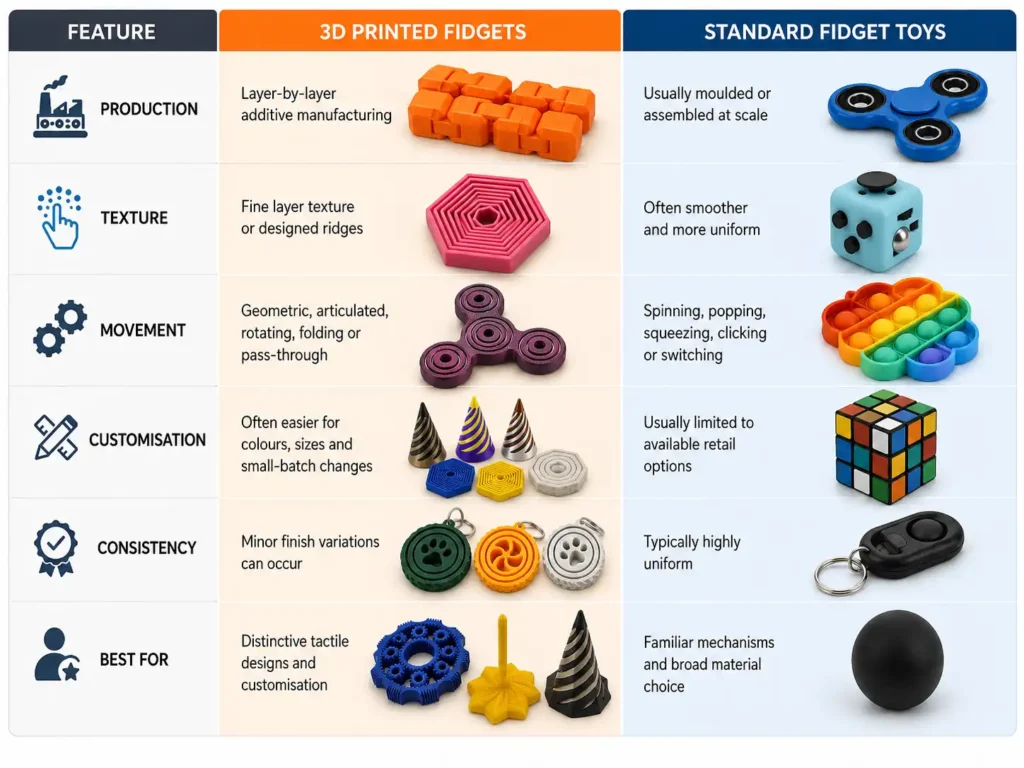
| Feature | 3D Printed Fidgets | Standard Fidget Toys |
| Production | Layer-by-layer additive manufacturing | Usually moulded or assembled at scale |
| Texture | Fine layer texture or designed ridges | Often smoother and more uniform |
| Movement | Geometric, articulated, rotating, folding or pass-through | Spinning, popping, squeezing, clicking or switching |
| Customisation | Often easier for colours, sizes and small-batch changes | Usually limited to available retail options |
| Consistency | Minor finish variations can occur | Typically highly uniform |
| Best for | Distinctive tactile designs and customisation | Familiar mechanisms and broad material choice |
A useful rule: choose by movement, sound, size and texture first, then decide which manufacturing method suits those preferences.
What Are 3D Printed Fidgets?
A 3D printed fidget begins as a digital model and is produced by adding material in successive layers. This can make articulated links, rotating rings, interlocking geometry, folding structures, and print-in-place movement practical.
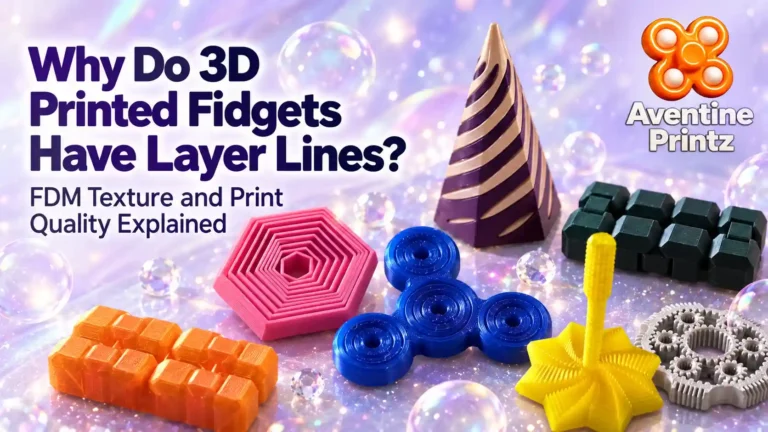
The surface can also feel different. Fine layer lines, ridges and patterned areas may become part of the tactile experience rather than simply a manufacturing detail.
For people who enjoy tactile desk toys, that combination of movement and surface feedback can be part of the appeal.
What Are Standard or Mass-Produced Fidgets?
“Standard fidget toy” is a broad category that can include silicone poppers, spinners, cubes, tangles, squeeze toys, sliders, and button-based products.
These mass-produced fidgets often provide highly consistent finishes and a wider range of materials. A silicone popper offers soft resistance, while a metal spinner can provide additional weight and sustained rotation.
That is why a 3D-printed fidget is not automatically a replacement for every conventional fidget.
1. Texture and Tactile Feedback
Texture is one of the clearest differences.
3D printed sensory toys can feature fine layer lines, geometric patterns, and designed ridges. Some people enjoy this textured feel when they want repetitive hand movement at a desk, at home or while travelling.
Standard fidgets may offer smooth plastic, soft silicone, rubberised surfaces, or metal. If you prefer something squeezable or very smooth, a conventional fidget may be the better fit.
The useful question is:
Which surface would you actually enjoy touching repeatedly?
2. Movement and Interaction
Movement is often the deciding factor.
3D printing can produce articulated sections, rotating pieces, pass-through shapes, and complex geometric movement within one design.
Standard fidgets can offer mechanisms such as silicone popping, spring-loaded buttons, or bearing-based spinning.
For office, classroom, or study use, sound also matters. Some articulated products are more noticeable than quiet rotating or sliding designs.
Choose the movement you enjoy first; the manufacturing method comes second.
3. Customisation and Design Choice
Customisation is one of the strongest reasons buyers explore 3D printed fidgets.
Because the product starts as a digital design, colours, dimensions, quantities and selected features can sometimes be adjusted without creating an entirely new production setup.
This can be particularly useful for gifts, themed colours, group orders or shoppers who already know the interaction they prefer.
At Aventine Printz Ltd, for example, custom requests can be reviewed for different colours, sizes, quantities and new fidget ideas.
This gives shoppers a practical option when an off-the-shelf product is almost right — but not quite.
Mass-produced fidgets still have an advantage when you simply want a familiar design that is ready to buy.
4. Small-Batch Production vs Mass Production
Mass-produced fidgets are designed for scale, repeatability and broad availability.
Small-batch 3D printing makes lower-volume and more specialised designs practical.
Aventine Printz Ltd uses this small-batch production approach in the UK, with products manually checked before packing. For shoppers, the benefit is not simply that “UK-made is better”; smaller-scale production can support a wider mix of designs and make certain custom requests more practical.
It is also important to remember that 3D printed does not automatically mean UK-made.
If you specifically want UK-made fidgets, check where the seller states that production actually takes place.
5. Consistency and Finish
Mass-produced items generally offer strong unit-to-unit consistency.
3D printed products can also be consistent, but small variations in layer appearance, surface finish or filament colour may occur.
These characteristics are part of the layer-by-layer production process and should be understood rather than hidden.
If a perfectly smooth, factory-uniform finish is important to you, a conventional product may suit you better.
If unusual geometry, visible printed character, or tactile texture matters more, a 3D printed design may be more appealing.
6. Which Type Is Better for Desk Use?
For desk use, focus on four things:
- Sound
- Size
- Movement
- Visual distraction
A compact rotating or sliding 3D printed fidget can sit neatly beside a keyboard. A larger articulated design may suit someone who wants a more noticeable tactile break.
The same applies to standard fidgets. A quiet silicone design may work well in a shared workspace, while a click-heavy cube may not.
If you are unsure which movement you prefer, exploring several styles in a sensory fidget bundle can be more practical than choosing one product purely by appearance.
This allows you to discover whether you naturally prefer twisting, folding, rolling, rotating, or another type of repetitive hand movement.
7. Which Type Offers Better Value?
Value depends on what you actually need.
A basic mass-produced fidget may be inexpensive and widely available. A specialist 3D-printed product may reflect longer printing time, smaller production runs, design complexity, or manual checking.
However, a higher price only represents better value if those differences matter to you.
Compare the actual product:
This gives you a more useful comparison than assuming one manufacturing method is always better value.
Are There Downsides to 3D Printed Fidgets?
Yes.
A balanced comparison should acknowledge them.
3D printed fidgets may show layer lines, require more care around excessive heat, take longer when customised, and sometimes create more sound when articulated sections move together.
Not every sensory experience is best created using rigid printed material.
Standard fidgets have trade-offs too. They may provide less personalisation, fewer unusual geometric designs and fewer opportunities for small custom production runs.
The better choice is the one that matches the user rather than the manufacturing trend.
What Should UK Buyers Check Before Choosing a Fidget?
Before purchasing any fidget, check:
- Movement type
- Size and portability
- Expected sound
- Material and surface feel
- Product care information
- Age and safety guidance where relevant
- Delivery and returns
- Available customisation
For children’s products, always follow the product-specific age guidance and warnings rather than assuming that words such as “sensory” or “3D printed” make an item suitable for every age.
How Aventine Printz Ltd Approaches 3D Printed Fidgets
Aventine Printz Ltd produces small-batch 3D printed fidgets and sensory bundles in the UK, using PLA, PLA+ and Silk PLA across its range.
Products are manually checked before packing, while custom requests can be reviewed for different colours, sizes, quantities or designs.
That hands-on production experience is also why choosing by practical characteristics matters.
If you are still discovering what feels right, browsing individual 3D printed fidget toys can help you compare different mechanisms.
If you would rather experience several types of movement, sensory fidget bundles bring different styles together in one collection.
And once you already know the colour, dimensions, or interaction you want, exploring a custom 3D printed fidget may be the more logical next step.
The aim is not to choose the most complicated fidget. It is to find the movement you genuinely enjoy returning to.
3D Printed Fidgets vs Standard Fidget Toys: Which Should You Choose?
Choose a 3D printed fidget when you value distinctive geometry, textured surfaces, unusual movement or customisation.
Choose a standard fidget toy when you prefer a particular material or familiar mechanism such as silicone popping, squeezing, switches or bearing-based spinning.
Neither category wins every comparison.
The best fidget is the one whose movement, texture, sound and size fit the way you actually plan to use it.
Frequently Asked Questions
Are 3D printed fidgets better than standard fidget toys?
Not always. 3D printed fidgets can offer unusual shapes, textured surfaces and greater customisation, while standard fidgets often provide broader material choices and highly consistent finishes.
Are 3D printed sensory toys good for desk use?
They can be. Look for a size, movement type and sound level that suits your workspace. Quiet rotating, sliding or tactile designs can be practical options for desk use.
What are UK-made fidgets?
UK-made fidgets are products manufactured in the United Kingdom. A fidget being 3D printed does not automatically mean it is UK-made, so check the seller’s production information.
Can 3D printed fidgets be customised?
Often, yes. Depending on the design, makers may be able to change colour, size, quantity or selected features. Aventine Printz Ltd reviews custom fidget requests before confirming whether a requested variation is practical.
Do 3D printed fidgets have visible lines?
They can. Fine layer lines are a normal characteristic of layer-by-layer 3D printing and may also contribute to the tactile surface of the finished product.