Hassle-free 14-day standard returns • 30-day free replacement warranty if your 3D print is faulty!
Hassle-free 14-day standard returns • 30-day free replacement warranty if your 3D print is faulty!
Why Do 3D Printed Fidgets Have Layer Lines?

Why do 3D printed fidgets have layer lines? They appear because FDM 3D printers create products by placing thousands of thin layers of melted PLA filament on top of each other. These visible textures are a normal part of the 3D printing process and do not mean a fidget toy has poor quality. At Aventine Printz Ltd, every sensory tool is carefully designed and printed in the UK with attention to durability, movement, and tactile experience.
If you are new to 3D-printed sensory toys, you may notice small ridges or textures across the surface of a fidget. Many people initially wonder whether these lines mean the product is unfinished or lower quality.
The reality is quite different.
Layer lines are a natural result of how FDM printing works. They show that the product has been carefully created through an additive manufacturing process rather than produced through traditional plastic moulding.
For a brand like Aventine Printz Ltd, these details represent the craftsmanship behind each product. Every fidget is designed, printed, checked, and prepared in a London-based workshop to create satisfying sensory tools that support focus, calm, and everyday enjoyment.
What Are Layer Lines in 3D Printing?
Layer lines are the small visible patterns created when a 3D printer builds an object one layer at a time.
Most 3D printed fidgets use a manufacturing process called FDM printing, which means Fused Deposition Modelling. Instead of creating an object from a mould, the printer follows a digital design and gradually builds the final shape.
The process works like this:
- A 3D model is converted into hundreds or thousands of printable layers.
- PLA filament is heated until it becomes flexible.
- The printer nozzle places the material in precise patterns.
- Each new layer bonds with the previous layer.
- The finished object develops its final shape and texture.
Because the product is built gradually, a slight 3D print texture can naturally appear on the surface.
This texture is not a defect. It is a visible reminder of the technology used to create the product.
Why Do FDM Printed Fidgets Have Visible Lines?
There are several reasons why layer lines appear on 3D printed fidgets.
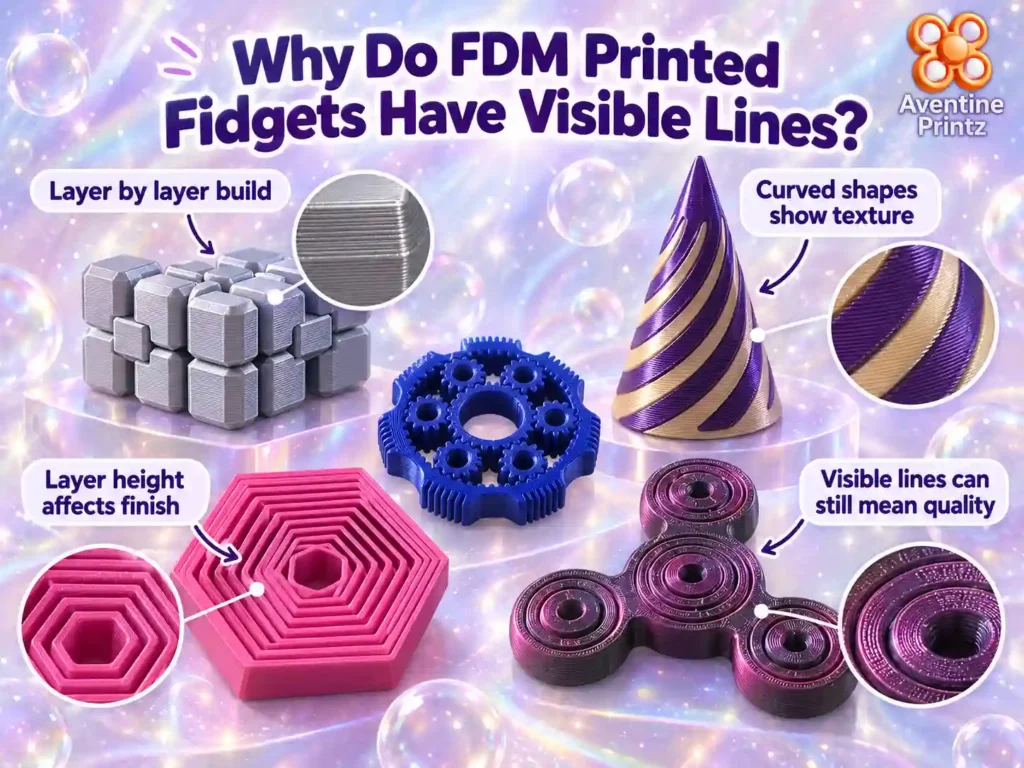
FDM Printing Creates Objects Layer by Layer
The biggest reason is the printing method itself.
Traditional plastic products are often made using injection moulding, where liquid plastic is pushed into a mould to create a smooth surface.
FDM printing works differently.
The printer builds the object from the bottom upwards. Each layer adds more detail until the complete design is finished.
This allows creators to produce:
- Unique shapes
- Custom sensory designs
- Moving parts
- Small-batch products
- Functional fidget mechanisms
However, the trade-off is that some layer texture may remain visible.
Curved Shapes Can Make Layer Lines More Noticeable
Many sensory fidgets include rounded edges, spinning parts, and detailed moving components.
These curved areas can reflect light differently, making the layer patterns easier to see.
This is especially common with:
- Circular designs
- Flexible mechanisms
- Complex moving parts
- Textured surfaces
For sensory products, these designs are often intentional because the shape and movement contribute to the overall experience.
Layer Height Affects the Final 3D Printed Toy Finish
One of the biggest factors affecting a 3D printed toy finish is layer height.
A smaller layer height usually creates a smoother appearance because the printer creates thinner individual layers.
A larger layer height can make the lines more visible but may also reduce printing time.
Manufacturers often balance:
- Surface appearance
- Strength
- Printing efficiency
- Product durability
At Aventine Printz, the focus is not simply creating the smoothest possible surface. The priority is creating reliable sensory tools that feel satisfying and perform well during everyday use.
Are Layer Lines a Sign of Poor 3D Print Quality?
No, layer lines do not automatically mean a 3D printed fidget is poor quality.
A high-quality 3D printed product should be judged by more than surface smoothness.
Important signs of good print quality include:
- Accurate dimensions
- Strong layer bonding
- Smooth movement between parts
- Clean edges
- Consistent printing
- Comfortable handling
A perfectly smooth surface is not always necessary for sensory products.
Many users enjoy the unique texture of 3D printed items because it creates a different tactile experience compared with mass-produced plastic toys.
At Aventine Printz Ltd, quality means creating fidgets that are enjoyable to use, carefully made, and designed with purpose.
Looking for a high-quality 3D-printed fidget designed for everyday use?
Explore Aventine Printz’s UK-made sensory toys, carefully created with precision printing, durable PLA materials, and attention to satisfying tactile feedback.
Why Are 3D Printed Fidgets Popular for Sensory Use?
3D printing has changed how sensory products can be designed and produced.
Traditional manufacturing often requires expensive moulds, which makes small custom designs difficult and costly.
3D printing allows independent creators to develop unique sensory tools that are tested, improved, and produced in smaller quantities.
This makes it possible to create fidgets designed around specific needs, including:
- Focus support
- Stress relief
- Calm moments
- Desk-friendly movement
- Sensory exploration
Aventine Printz Ltd was created from a personal experience with sensory tools.
Founder Charlie discovered the impact of a simple 3D printed fidget after receiving one from a friend. The experience showed how a small object could support concentration, reduce restlessness, and provide a moment of calm.
That discovery inspired the creation of a family-run UK business focused on making sensory products that bring focus, calm, and joy to everyday life.
Does 3D Print Texture Affect How a Fidget Feels?
Yes, the texture of a 3D printed fidget can influence the sensory experience.
The small surface patterns created during printing can contribute to:
- Grip
- Finger interaction
- Tactile feedback
- Overall feel of the product
For sensory products, the goal is not always to remove every sign of manufacturing.
The goal is to create something that feels enjoyable, functions properly, and provides a satisfying experience.
Aventine Printz carefully considers movement, design, and usability when creating each fidget. The company combines technical 3D printing knowledge with real-life understanding of sensory needs.
How Does Aventine Printz Maintain 3D Printed Fidget Quality?
Aventine Printz Ltd focuses on creating premium sensory tools through careful design, precise printing, and personal quality checks.
Founded by Charlie, a neurodivergent creator with ADHD, the brand was built from lived experience and a genuine understanding of the importance of focus and calm.
With 17 years of diverse problem-solving experience across different industries, Charlie brings practical skills and creative thinking into the 3D printing process.
Each product benefits from:
High Precision 3D Printing
Every fidget is carefully printed to achieve reliable movement, accurate shapes, and satisfying tactile feedback.
Purpose-Driven Designs
The designs are created to support focus, calm, creativity, and everyday sensory needs.
Sustainable PLA Materials
Eco-conscious PLA filament is used to create lightweight and durable products while considering environmental impact.
Personal Quality Checks
Unlike large-scale factories, Aventine Printz operates as a family-run London workshop where products receive individual attention before dispatch.
Every Aventine Printz fidget is created in a London workshop with care, from design testing to final quality checks.
Discover sensory tools made by a family-run UK brand that understands the importance of focus, calm, and satisfying movement.
Can Layer Lines Be Removed From 3D Printed Fidgets?
Layer lines can be reduced, but removing them completely often requires additional processing.
Common methods include:
- Printing with smaller layer heights
- Sanding surfaces
- Applying smoothing treatments
- Using different printing technologies
However, these methods can increase production time and may change the original feel of the product.
For sensory fidgets, maintaining durability, movement quality, and tactile satisfaction is often more important than achieving a completely smooth appearance.
The slight texture of an FDM-printed product is part of the manufacturing process that makes each item unique.
FDM Printing vs Other Manufacturing Methods
Different production methods create different surface finishes.
| Manufacturing Method | Surface Appearance | Common Uses |
| FDM Printing | Visible layer texture | Custom fidgets, functional products |
| Resin Printing | Smooth detailed finish | Small detailed models |
| Injection Moulding | Very smooth finish | Large-scale plastic production |
FDM printing is particularly valuable for brands creating unique products because it allows flexibility, creativity, and continuous improvement.
For a specialist sensory brand like Aventine Printz, this technology makes it possible to create designs that would be difficult to produce using traditional methods.
Frequently Asked Questions
Are layer lines normal on 3D printed fidgets?
Yes, layer lines are completely normal on 3D printed fidgets created using FDM printing. Since the product is built layer by layer, small textures may appear on the surface. These lines show the manufacturing process and do not mean the product is poorly made.
Why do my 3D printed fidgets have a rough texture?
3D printed fidgets can have a textured surface because FDM printers deposit melted filament in thin layers to create the final shape. Factors such as layer height, design complexity, printing speed, and filament type can affect the appearance of the finished product.
Does a smoother 3D printed toy mean better print quality?
Not necessarily. A smooth surface is only one part of print quality. A well-made fidget should also have strong construction, accurate movement, durable materials, clean finishing, and a comfortable tactile experience during everyday use.
What causes visible layer lines in FDM printing?
Visible layer lines happen because FDM printers create objects by placing many thin layers of melted filament on top of each other. The thickness of each layer, printer settings, and the shape of the design all influence how noticeable these lines appear.
Can 3D printed fidgets have a smooth finish?
Yes, 3D printed fidgets can have a smoother appearance by using smaller layer heights, different printing methods, or additional finishing techniques. However, some texture is normal with FDM printing and does not reduce the quality or functionality of a well-designed sensory product.
Are 3D printed fidgets good for sensory use?
Yes, many people enjoy 3D printed fidgets because they provide tactile feedback, movement, and a satisfying physical experience. The combination of texture, motion, and design can make them useful sensory tools for people looking for focus, calm, or stress relief.
Where can I buy high-quality 3D printed fidgets in the UK?
Aventine Printz Ltd creates 3D printed fidget toys and sensory tools from its London workshop. Each product is designed with purpose, printed using quality PLA materials, and checked carefully before being dispatched to customers across the UK.
Ready to find a sensory tool that fits your routine?
Explore Aventine Printz’s collection of 3D-printed fidget toys, designed and made in London to support focus, calm, and everyday sensory needs.