Hassle-free 14-day standard returns • 30-day free replacement warranty if your 3D print is faulty!
Hassle-free 14-day standard returns • 30-day free replacement warranty if your 3D print is faulty!
How Are 3D Printed Fidgets Made? Behind The Scenes Of UK Sensory Toy Creation

How Are 3D Printed Fidgets Made? They are created through a combination of digital design, 3D modelling, material selection, FDM printing, finishing, and quality testing. Unlike mass-produced toys, 3D printing allows creators to develop unique sensory products with detailed designs and small-batch production.
A fidget toy may look simple when it arrives in your hand, but the journey behind it involves careful planning, technology, and product expertise.
From the first digital concept to the final quality check, every stage affects how the fidget feels, moves, and performs.
At Aventine Printz Ltd, a London-based family-run business, every 3D-printed fidget is created with a focus on tactile experiences, practical design, and everyday enjoyment. Founded by Charlie, a neurodivergent creator with lived ADHD experience, Aventine Printz Ltd develops UK-made sensory products designed around focus, calm, and creativity.
This guide explains exactly how 3D printed fidgets are made, including the design process, materials used, printing technology, quality checks, and why UK-made fidgets offer a different experience compared with mass-produced alternatives.
What Are 3D Printed Fidget Toys?
3D printed fidget toys are tactile products created using additive manufacturing technology, where a physical object is built layer by layer from a digital design.
Unlike traditional manufacturing methods that often require expensive moulds and large production quantities, 3D printing allows creators to produce detailed designs with greater flexibility.
A 3D printed fidget can include:
- Moving mechanical designs
- Rotating fidgets
- Print-in-place fidgets
- Desk fidgets
- Sensory fidget bundles
- Tactile sensory toys
The purpose of these products is not only visual appeal. Good fidget designs focus on interaction through:
- Texture
- Movement
- Resistance
- Shape
- Hand comfort
Many UK-based 3D printing businesses use PLA filament because it provides detailed prints, reliable performance, and a wide range of colours.
You can explore Aventine Printz Ltd’s range of 3D Printed Fidget Toys created for different everyday uses.
How Are 3D Printed Fidgets Made Step By Step?
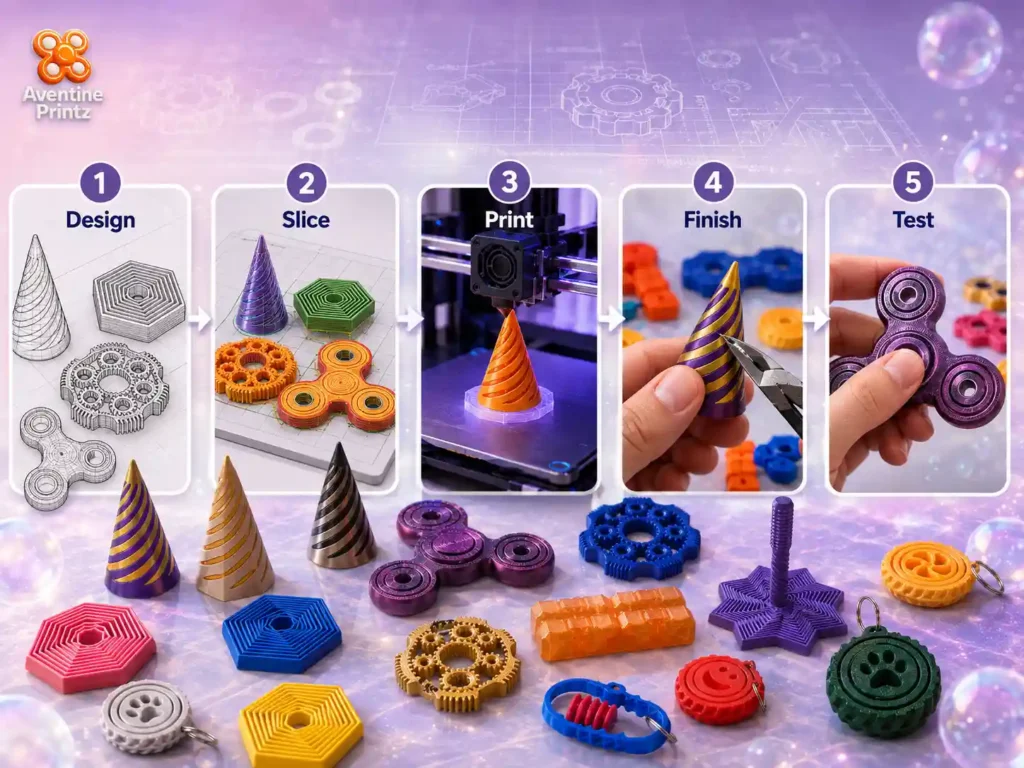
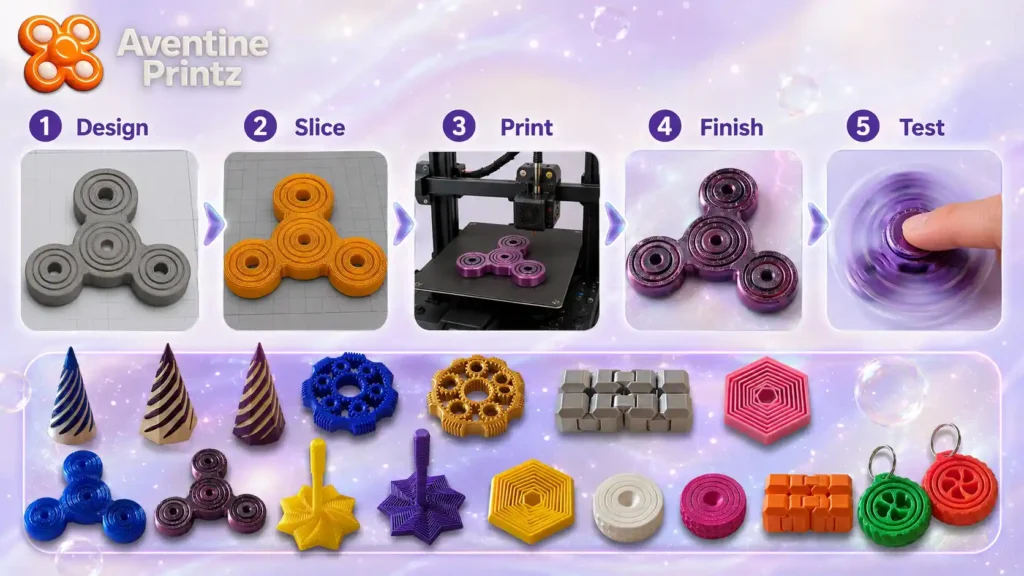
The process behind creating a 3D printed fidget involves several important stages. Each step influences the final product quality, movement, durability, and user experience.
Step 1: Creating The 3D Printing Design
Every 3D printed fidget begins as a digital idea.
Before anything reaches a printer, designers create a 3D model that defines:
- The overall shape
- Moving components
- Surface details
- Internal structure
- Product dimensions
The 3D printing design process requires more than creating an attractive shape.
A functional fidget must consider:
- How comfortably it fits in the hand
- How different parts interact
- How much movement resistance is needed
- Whether the mechanism works smoothly
For example, a print-in-place fidget requires extremely accurate spacing between moving parts. Small design changes can determine whether the product moves smoothly or becomes difficult to operate.
At Aventine Printz Ltd, designs are influenced by real-world experience with sensory needs and the importance of creating satisfying tactile interactions.
Step 2: Preparing The Digital Model For Printing
After completing the digital design, the file must be prepared for the 3D printer.
The model is usually converted into a printable format such as an STL file.
The STL file is then processed using slicing software.
Slicing software converts the design into instructions that the printer understands.
Important settings include:
- Layer height
- Printing speed
- Infill percentage
- Support structures
- Printing direction
- Temperature settings
These settings directly affect:
- Surface quality
- Strength
- Detail accuracy
- Movement performance
A well-prepared file helps create smoother and more reliable 3D printed sensory toys.
Step 3: Selecting The Right Filament Material
The material used during printing has a major impact on the final fidget experience.
Aventine Printz Ltd uses eco-conscious PLA filament for many products.
PLA is popular for 3D printed fidgets because it offers:
- Detailed surface quality
- Strong colour options
- Lightweight handling
- Reliable printing performance
- Smooth finished appearance
Different materials can create different results.
For example:
PLA Filament
Best known for:
- Detail accuracy
- Colour variety
- Everyday fidget designs
PETG
Often chosen when additional durability is required.
TPU
Used when flexible movement or softer material properties are needed.
The correct material choice depends on the purpose of the product and the desired tactile experience.
Step 4: The FDM 3D Printing Process
Most 3D printed fidget toys are created using FDM 3D printing.
FDM means Fused Deposition Modelling.
During the process:
- Filament enters the printer
- The heated nozzle melts the material
- The printer places thin layers onto the build surface
- Each layer connects with the previous layer
- The final object gradually takes shape
The printing process requires careful calibration.
Factors such as:
- Temperature
- Print speed
- Layer settings
- Material flow
can influence the final result.
A professionally produced fidget is not simply created by pressing a button. Experience with printer settings and product requirements plays an important role in achieving consistent quality.
Step 5: Finishing And Quality Checking
After printing finishes, the product goes through inspection.
Quality checking may include:
- Checking surface quality
- Testing moving parts
- Inspecting colour consistency
- Checking print accuracy
- Ensuring comfortable movement
For sensory products, quality control is especially important because the user experience depends on how the product feels in the hand.
A fidget should provide:
- Smooth movement
- Comfortable handling
- Reliable interaction
- Satisfying tactile feedback
At Aventine Printz Ltd, every product is created with attention to precision printing, practical design, and everyday usability.
How Are Fidget Designs Created For Sensory Experiences?
A successful sensory fidget is designed around interaction.
The best designs consider several important factors.
Texture
Surface patterns and shapes influence how the product feels during use.
Movement
Different mechanisms create different experiences:
- Rotating
- Clicking
- Twisting
- Expanding
- Sliding
Size
A fidget designed for a classroom may need different characteristics compared with an adult desk fidget.
Portability
Many users want products that fit naturally into:
- Workspaces
- Classrooms
- Travel bags
- Home environments
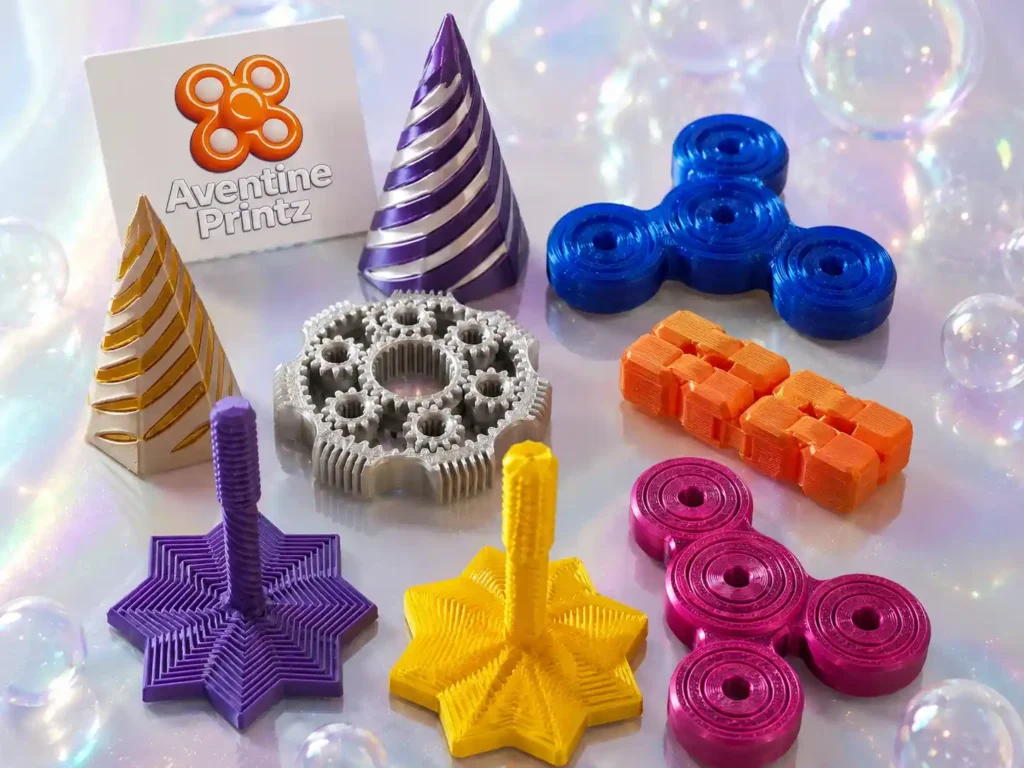
Aventine Printz Ltd creates collections for different needs.
Why Are 3D Printed Fidgets Different From Mass Produced Toys?
Traditional toy manufacturing usually depends on large-scale production methods.
3D printing creates a different opportunity.
Unique Product Designs
Creators can develop shapes and mechanisms that may not be practical with traditional manufacturing.
Small Batch 3D Printing
Small batch production allows businesses to create products with more flexibility and attention to detail.
Faster Product Development
New ideas can be tested and improved without creating expensive moulds.
More Creative Freedom
Designers can experiment with:
- Shapes
- Colours
- Movement styles
- Sensory features
This makes 3D printing especially valuable for sensory products where user experience matters.
Why Choose UK Made Fidgets From Aventine Printz Ltd?
Aventine Printz Ltd is a London-based family-run 3D printing business creating sensory fidgets and tactile products from its UK workshop.
The brand was founded by Charlie, a neurodivergent creator who discovered the value of fidget products through personal experience.
What started with receiving a single 3D printed fidget developed into a mission to create products that bring focus, calm, and enjoyment into everyday life.
Charlie brings 17 years of diverse problem-solving experience across different industries, combining creativity with practical product development.
Every Aventine Printz Ltd product focuses on:
- High precision 3D printing
- Purpose-driven design
- Eco-conscious PLA materials
- Smooth movement
- Tactile feedback
- Careful UK production
Unlike mass-produced alternatives, Aventine Printz Ltd creates products in a London workshop where designs are developed, printed, checked, and prepared with care.
Explore the full range of Sensory Fidget Bundles created for different preferences and everyday situations.
Are 3D Printed Fidgets Made In The UK?
Yes, many independent businesses create UK-made fidgets using 3D printing technology.
Aventine Printz Ltd produces and dispatches products from London, offering customers access to locally created sensory tools.
Choosing UK-made fidgets provides benefits such as:
- Supporting independent makers
- Better production visibility
- Small batch attention
- Unique product designs
For customers searching for “3D printed fidgets UK” or “3D printed fidgets near me”, locally produced products provide a more personal alternative to mass-produced imports.
How Much Does It Cost To Make A 3D Printed Fidget?
The cost of producing a 3D printed fidget depends on several factors:
- Product size
- Printing time
- Filament usage
- Design complexity
- Finishing requirements
A small, simple fidget may require less material and printing time, while a complex mechanical design may take significantly longer.
Small batch 3D printing allows creators to produce unique products without the high upfront costs associated with traditional manufacturing.
Frequently Asked Questions
How are 3D printed fidgets made?
3D printed fidgets are made by creating a digital model, preparing the design with slicing software, printing with FDM technology, selecting suitable materials, and completing quality checks before reaching customers.
What material are 3D printed fidgets made from?
Many 3D printed fidgets are made from PLA filament because it provides detailed printing, reliable performance, lightweight handling, and a wide range of colour options.
What is FDM 3D printing?
FDM 3D printing is a manufacturing method where melted filament is deposited layer by layer to create a three-dimensional object from a digital design.
Are print-in-place fidgets assembled?
No. Print-in-place fidgets are designed so moving parts are created together during printing, reducing the need for manual assembly after production.
Are UK-made fidgets better than imported alternatives?
UK-made fidgets often provide greater production transparency, smaller batch attention, and closer quality checking compared with mass-produced alternatives.
How long does it take to make a 3D printed fidget?
Production time depends on the design size, complexity, material usage, and printing settings. Larger mechanical fidgets usually require more printing time.
Where can I buy 3D printed sensory toys in the UK?
Customers can explore Aventine Printz Ltd’s 3D printed sensory toys, fidget bundles, and tactile products created in the UK.